Cybersecurity · AI · Education · Lifelong learning
The answer to AI misuse is AI literacy
Google is giving its cybersecurity learners three months of Google AI Pro. As I resume my own cybersecurity journey, I ask why so many of our universities still treat AI only as a threat, and why Africa needs educators who evolve with it.

Today I resumed the Google Cybersecurity Professional Certificate through the One Million Coders Programme (OMCP), as a step towards my CompTIA certifications. I am taking it alongside the Founders Academy programme with ALX.
Somewhere between lessons, I remembered something my pastor once told me during a Bible discussion: “You like making references.” Well, Pastor, here is another one.
A lesson that was not on the syllabus
A few modules into Foundations of Cybersecurity, between a reading on common attacks and a quiz on the history of the field, Coursera showed me this:
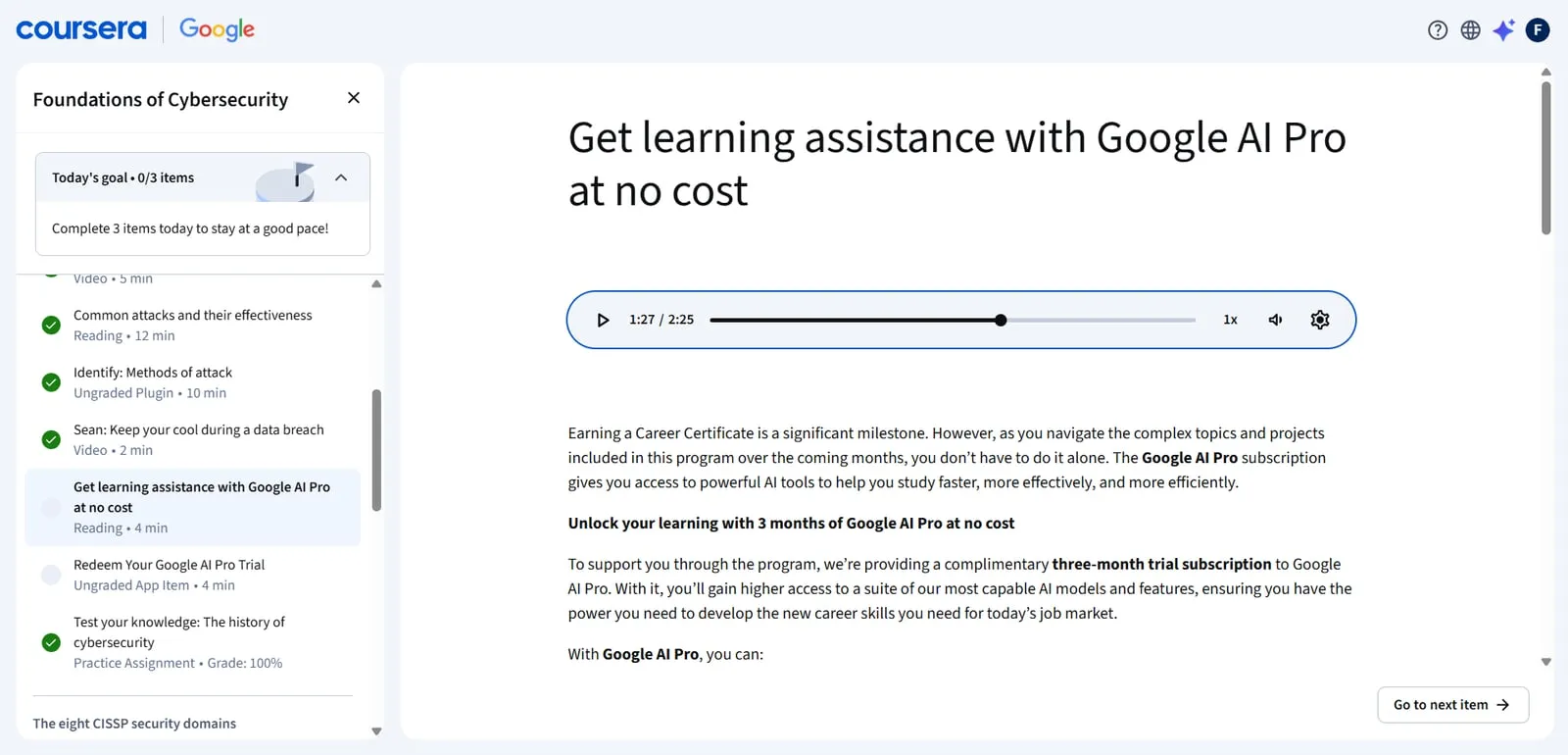
Google is giving learners on the programme three months of Google AI Pro at no cost, to help them “study faster, more effectively, and more efficiently.”
For me, this is more than a free subscription. It is motivation to stay committed, finish what I started and make full use of the opportunity. I intend to use it to understand security concepts, research vulnerabilities, deepen my technical knowledge and draft security documentation.
The offer also says something bigger. One of the world’s leading technology companies has decided that AI belongs inside professional training, not outside it.
AI is an assistant, not a substitute
That does not mean handing my thinking over to a machine. AI is no substitute for critical thinking, technical competence or professional judgement. It makes mistakes. A security practitioner has to verify what it produces, keep sensitive information out of it and understand the systems they are protecting.
The goal is not to let AI think for me. It is to use AI to think, learn and work better.
Where our classrooms are falling behind
Recently, a friend and I discussed how dated some approaches to teaching and learning in our universities have become.
I want to be careful here. A doctorate or a professorship represents years of hard work, research and sacrifice, and that deserves respect. But respect should not stop us from being honest: many of our lecturers and educationists have become too conservative in their approach to knowledge, technology and learning.
While leading technology companies explore how AI can improve productivity, research and professional practice, some lecturers still treat AI mainly as a threat to academic integrity, rather than a technology that needs to be thoughtfully integrated into education.
The concern is legitimate. AI can make plagiarism and academic dishonesty easier. But banning, dismissing or resenting AI will not prepare students for a world where they will meet it in almost every profession.
Lecturers should be teaching students how to:
- use AI responsibly, within clear rules;
- question its outputs instead of accepting them;
- verify information against reliable sources;
- solve problems independently, with or without the tool;
- apply their knowledge to real, practical situations.
The answer to the misuse of AI is not ignorance of AI. It is AI literacy.
Learn, unlearn, relearn
This may be part of why I have never been comfortable defining myself strictly by a generation, religion, culture or race. I see myself first as a human being who is still evolving: learning, questioning, unlearning and relearning.
I respect tradition, but I do not confuse tradition with permanence. I respect authority, but I do not believe authority should be beyond question. And I respect academic achievement, but I believe expertise must come with a willingness to grow.
A professor can have decades of experience and still learn something new from a younger person. A student can be inexperienced and still bring an idea that transforms a whole field.
Knowledge does not become obsolete because it is old. An approach to knowledge becomes obsolete when it refuses to evolve.
What Africa needs from its educators
Africa cannot afford to raise graduates who are prepared only for the world that existed when their lecturers were students. We need educators who are not just custodians of existing knowledge, but guides who prepare learners for what is emerging.
The future will not wait for our institutions to become comfortable with change.
My commitment
As I continue my cybersecurity journey and the Founders Academy programme, I am committing to stay teachable, curious and adaptable. In a world that keeps changing, the most dangerous position is not knowing less than someone else. It is believing you already know enough to stop learning.
We must learn, unlearn, relearn and evolve.
And Pastor, I hope this counts as another useful reference.